Likely Neurodivergence and Variant Connective Tissue in Patients with Chronic Pain/Chronic Fatigue: a Case-Control Study

Trans-Diagnostic Screening: Joint Hypermobility Explains the Link Between Neurodivergence and Chronic Pain/Fatigue
In an online case-control survey, UK-based researchers investigated the relationship between neurodivergent traits and chronic pain and/or chronic fatigue (CP/CF). The study compared 83 adults experiencing CP/CF with 91 non-clinical participants using validated screening measures for autism, ADHD, and joint hypermobility—a known marker of variant connective tissue. While both groups were assessed for neurodivergent traits, a notable finding emerged: participants with CP/CF had significantly higher odds of meeting threshold criteria for likely autism (OR 14.3) and ADHD (OR 12.9). Furthermore, mediation analysis revealed that joint hypermobility significantly explained this association. These findings point to an underlying systemic connection and highlight a critical need for routine screening for neurodivergence and joint hypermobility in CP/CF patients to ensure appropriate support.
Listening Beyond the Noise: an Interpretative Phenomenological Analysis of Mental Fatigue and Restoration in Neurodivergent Students’ Acoustical Environments

Acoustical Compatibility Over Imposed Silence: Redefining Mental Restoration for Neurodivergent Students
In a qualitative interpretative phenomenological analysis, researchers explored how self-directed learning soundscapes impact mental fatigue and cognitive restoration in neurodivergent university students. Through in-depth online interviews, students who self-identified as Autistic, ADHDers, or AuDHDers described how environmental sound shaped their ability to focus and regulate emotion. While traditional educational settings often enforce quietness, a notable finding emerged: imposed silence was frequently experienced as emotionally taxing rather than restorative. Instead, participants found cognitive safety and restoration in “acoustical compatibility”—environments that offered predictability, personal salience, and control. These findings point to a need for sensory-inclusive educational policies that prioritise personal soundscape management over mandatory silence.
Shared Developmental Programs in ASD
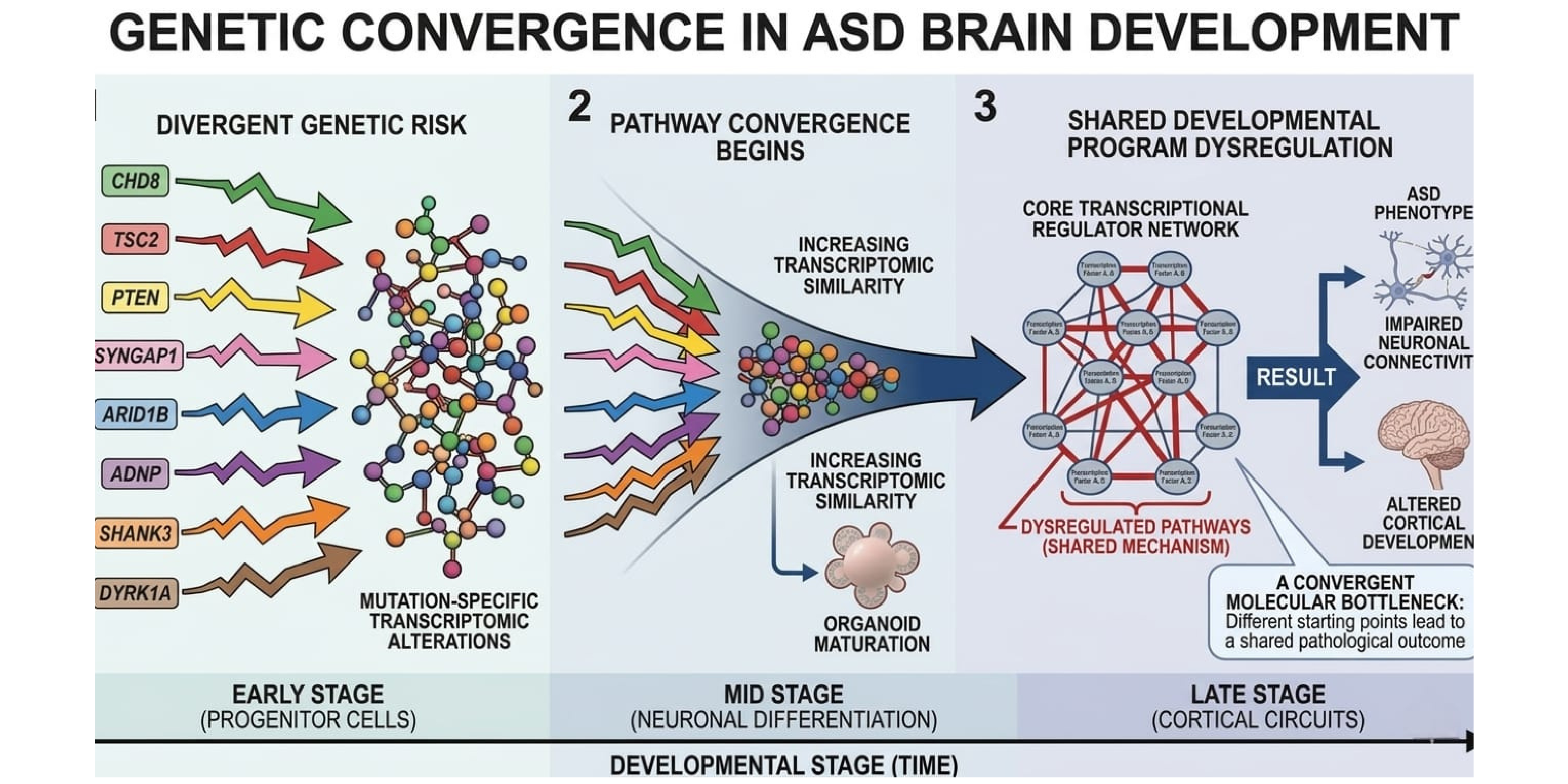
Shared Developmental Programs in Autism Spectrum Disorder: Emerging Neurobiological Insights
In a recent publication in Nature Neuroscience, researcher Ana Uzquiano investigated the underlying neurobiological and cellular mechanisms that drive Autism Spectrum Disorder (ASD). By examining the early stages of neurogenesis and synaptic formation, the author explored how various genetic and environmental risk factors influence brain wiring during development. While the condition is known for its complex heterogeneity, a notable perspective emerged: diverse risk factors often converge on shared developmental trajectories and cellular programs. These findings point to a unified framework for understanding the biological origins of ASD, suggesting that recognising these common developmental pathways could pave the way for more targeted early interventions.
Cognitive Behavioural Therapy is not Universally Evidence-Based: Implications for Eating Disorders

The Methodological Echo Chamber: Questioning the Universal Evidence Base of CBT in Eating Disorders
In a critical conceptual paper published in the Journal of Eating Disorders, a researcher challenged the assumption that Cognitive Behavioural Therapy (CBT) is a universally evidence-based treatment. By analysing the underlying populations and outcome measures in typical CBT trials, the author argued that current research heavily prioritises internal validity, largely relying on white, Western, and neurotypical samples. A notable finding emerged: standard CBT pathways for eating disorders often lack external validity and can even cause iatrogenic harm to neurodivergent individuals and Indigenous communities by overlooking sensory, cultural, and sociopolitical drivers of distress. These findings point to an urgent need for co-designed, culturally valid measurement tools, cautioning against applying Eurocentric, neuronormative cognitive models to diverse populations without specific implementation evidence.
Neuroimmune Clearance and EEG Biomarkers: A Unified Model of ASD and Dyslexia

Neuroimmune Clearance and Cortical Connectivity: A Unified EEG Model for ASD and Dyslexia
In a comprehensive theoretical review, researchers investigated the intersection of neuroimmunology, cerebrovascular biology, and electrophysiology to explain neurodevelopmental conditions like Autism Spectrum Disorder (ASD) and developmental dyslexia. The authors synthesised existing literature to propose a model linking the brain’s meningeal lymphatic system and microglial synaptic pruning to electroencephalography (EEG) signatures. A notable concept emerged: impaired meningeal lymphatic clearance may sustain neuroinflammatory states that disrupt microglial homeostasis, which in turn could drive the patterns of cortical underconnectivity or hyperconnectivity observed in these conditions. These insights point to a testable theoretical framework where altered EEG frequency bands—such as increased slow-wave power—could eventually serve as translational biomarkers for underlying neuroimmune dysregulation.
Supporting Neurodiverse Junior Doctors: Challenges, Strategies, and Policy Implications for Inclusive Medical Training

Systemic Inclusion Over Individual Resilience: Reframing Medical Training for Neurodiverse Junior Doctors
In an editorial published in Cureus, researchers examined the structural and cultural barriers faced by neurodivergent junior doctors—including those with ASD, ADHD, and dyslexia—within highly demanding clinical environments. Drawing on professional frameworks from bodies like the General Medical Council and NICE, the authors analysed how rigid shift rotations, sensory overload, and administrative burdens disproportionately disadvantage cognitive variation. A notable perspective emerged: rather than relying on individual remediation, healthcare systems must adapt organizationally by implementing predictable scheduling, structured mentorship, and assistive technologies. These recommendations point to a critical shift in medical education policy, suggesting that embracing cognitive diversity not only reduces burnout and stigma but also enriches diagnostic reasoning and the overall quality of patient care.